Last updated March 2026
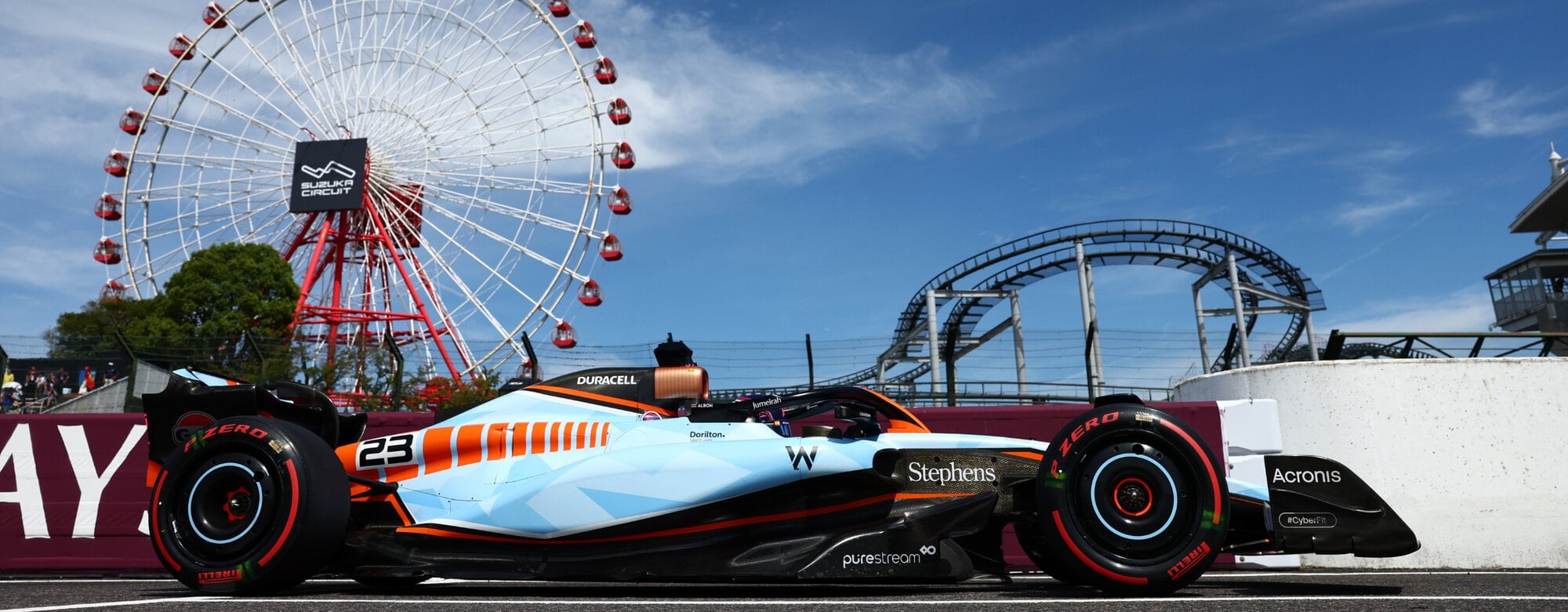
Suzuka isn’t just another race on the calendar. It’s an iconic circuit revered by drivers and fans alike, celebrated worldwide for its electric atmosphere, technical challenge, and the only figure-of-eight layout in Formula 1.
What to Expect in This Guide
• Why the Japanese Grand Prix should be on your F1 bucket list
• Where’s the circuit?
• Travelling to Japan and Suzuka: What you need to know
• How many days should you spend at the Japanese Grand Prix?
• Japanese Grand Prix weekend schedule at a glance
• Best places to stay for the Japanese Grand Prix
• Race weekend travel at the Japanese Grand Prix
• Best grandstands for key moments
• Where next after the Japanese Grand Prix?
• Japanese Grand Prix FAQ
• Money-saving tips for the Japanese Grand Prix
Estimated reading time: 8–10 minutes
Why the Japanese Grand Prix should be on your F1 bucket list
Few circuits on the Formula One calendar command the respect of drivers quite like Suzuka. Its high-speed, flowing layout, technical corner sequences, and passionate fans combine to create one of the sport’s most iconic race weekends.
Drivers around the world consider it one of the greatest permanent circuits ever built. The lap is fast, flowing, and demanding. There is almost no time to relax between corners. Drivers must constantly balance speed and precision while pushing the car to its limit.
The opening sector is where Suzuka earns its reputation. It begins with the Esses, a sequence of narrow, flowing corners that climb uphill before falling away again. Each corner leads directly into the next. Drivers must carry momentum while placing the car with precision.
Further around the lap are corners that demand full commitment. Spoon Curve is long and technical. 130R is one of the fastest and most famous corners in Formula One. Getting these corners right can make a significant difference to lap time.
Drivers often say Suzuka rewards rhythm and confidence. Lose momentum early in the lap, and it is difficult to recover it.
Oscar Piastri explains it well, “Suzuka is one of the most exciting circuits on the calendar for us as drivers. 130R is legendary and the combination of fast corners and the fact that the circuit has remained the same for so many years means it’s an incredible feeling to race here.”
Suzuka has also played an important role in Formula One history. Several world championships have been decided here.

In 1996, Damon Hill secured the title after an intense season-long battle with his Williams teammate Jacques Villeneuve. In 2000, Michael Schumacher won at Suzuka to secure his first championship with Ferrari. He repeated the achievement in Japan again in 2003.
Other champions, including Ayrton Senna, Mika Häkkinen, and Sebastian Vettel, have also been crowned world champion at this circuit.
For fans attending in person, the atmosphere is just as memorable as the racing.
Japanese Formula One fans are known for their passion and creativity. Many arrive in detailed team outfits, homemade helmets, and elaborate headwear inspired by their favourite drivers. Grandstands fill early, and the crowd follows every moment of the weekend closely.

Drivers often talk about how special that support feels. As Lando Norris puts it, “It’s one of my favourite weekends on the calendar. The fans bring an amazing atmosphere. Suzuka as a circuit is also a great one to drive at.”
For many Formula One fans, attending Suzuka at least once is a true bucket-list experience.
Where’s the circuit?
Suzuka Circuit is in the city of Suzuka, in Mie Prefecture on Japan’s main island of Honshu.
It is about 30 miles (50 km) south of Nagoya, the nearest major city.
Suzuka itself is smaller and quieter. It is not a large metropolis like Tokyo or Osaka.
Many fans stay in Nagoya and travel to the circuit on race days. Others combine the race with time in Kyoto or Osaka, which are also within reach.
Traveling to Japan & Suzuka: What you need to know
Most long-haul flights to Japan arrive at Tokyo’s Narita Airport (NRT) or Osaka’s Kansai Airport (KIX).
From either city, you can take the Shinkansen, Japan’s high-speed train, to Nagoya. The journey is straightforward and reliable. It is also one of the easiest ways to experience Japan’s well-known rail network.
Some fans also fly directly to Nagoya’s Chubu Airport (NGO) on domestic flights. Finnair operates a direct route to Nagoya from Helsinki, with connections from several cities across Europe.
Many visitors can enter Japan without a visa for short stays. However, entry rules depend on your nationality, so it is best to check the requirements before planning your trip.
How many days should you spend at the Japanese Grand Prix?
It’s best to plan for three full days, from Friday to Sunday. This allows you to see every Formula One session across the race weekend.
Arriving on Friday means you can watch both practice sessions as teams begin working through their race setups. Saturday includes final practice and qualifying, which decides the starting grid for the Grand Prix.
Alongside Formula One, the weekend also includes several support series. These often include Ferrari Challenge Japan and Porsche Carrera Cup Japan.
Track activity runs throughout the weekend, so staying from Friday through Sunday gives you the full experience of the event.
Japanese Grand Prix weekend schedule at a glance
Here’s a simple breakdown of what happens each day at the Japanese Grand Prix.
Friday begins with the first Formula One running of the weekend. Teams complete two practice sessions as they begin preparing their cars for qualifying and the race.
Support series are also on track throughout the day. These typically include Ferrari Challenge Japan and Porsche Carrera Cup Japan, with practice and qualifying sessions taking place between the Formula One sessions.
Saturday includes the final Formula One practice session, followed later by qualifying, which sets the starting grid for the Grand Prix. Support races and additional sessions from the support series take place throughout the day.
Sunday begins with the final support races in the morning. The Formula One drivers’ parade takes place before the main event of the weekend, the Japanese Grand Prix.

Best places to stay for the Japanese Grand Prix
Most travelling fans stay in Nagoya, the nearest large city to Suzuka Circuit. For many first-time visitors, it is the simplest place to base yourself during the race weekend.
Nagoya has a wide range of hotels. It also has good train and bus connections to the circuit and good rail connections to other major cities across Japan.
Hotels close to Nagoya JR Station are usually the most convenient. From here, you can access the train network and the Circuit Express bus service easily for services heading toward Suzuka.
Hotels within walking distance of Nagoya JR Station
Nagoya Marriott Associa Hotel, 1 minute walk
Nagoya JR Gate Tower Hotel, 4 minute walk
Mitsui Garden Hotel Nagoya Premier, 5 minute walk
ibis Styles Nagoya, 9 minute walk
Nikko Style Nagoya, 11 minute walk
The Strings Hotel Nagoya, 12 minute walk
Nagoya Prince Hotel Sky Tower, 16 minute walk
Courtyard by Marriott Nagoya, 18 minute walk
Hilton Nagoya, 19 minute walk
Staying near Nagoya Station makes it easier to travel to Suzuka each day and simplifies the journey back after the race.
Race weekend travel at the Japanese Grand Prix
Nagoya is the main base for travelling to the Japanese Grand Prix.
One option is a reserved-seat bus from Nagoya Station to Suzuka Circuit. The journey takes around two hours each way.
Trains are another option, but they require a transfer. You can travel by train to Suzuka Circuit Inō Station, which involves changing trains along the way.
Many fans instead travel to Shiroko Station. While it is not the closest station to the circuit, it has the most convenient train connections. Shuttle buses run between Shiroko Station and Suzuka Circuit during race weekend. At busy times, shuttle bus queues can be long. Waits of up to two hours are not unusual.
Train routes to Shiroko Station
From Nagoya
Take the Kintetsu Limited Express from Nagoya Station to Shiroko Station. The journey takes around 40 minutes.
From Osaka
Take the Kintetsu Limited Express from Osaka-Namba Station directly to Shiroko Station. The journey takes about 1 hour and 40 minutes.
From Kyoto
First take a JR train from Kyoto Station to Shin-Osaka Station. From there, transfer to the Kintetsu Limited Express to Shiroko Station. The total journey usually takes between two and two and a half hours.
Best grandstands for key moments at the Japanese Grand Prix
The start-finish straight (Grandstand V1 lower and V2 upper) is the place to soak up the pre-race build-up and the chequered flag. Before the race, you’ll see engineers making final preparations to the cars and the drivers coming and going on the grid.

Grandstands B, C and D border one of the most challenging sections of the circuit, the ‘S’ Curves, sweeping medium- and high-speed corners running from Turns 3 to 7. Bordered by grass and gravel traps, this narrow part of the circuit is where the changes of direction begin to come into full force as cars snake through a series of left- and right-handed corners.

Grandstand I – This is the largest grandstand at Suzuka and lines the outside of the exit of the hairpin. This is the slowest section of the circuit, where the cars rotate 180°, making it a prime overtaking spot. The hairpin at Turn 11 often sees drivers pull off an overtaking move, diving down the inside of the car ahead.


Grandstand P sits along the outside of the legendary high-speed 130R corner, where cars reach maximum velocity before slowing for the final chicane.
The final chicane (Grandstands Q, R and S) has been the site of dramatic moments throughout F1 history, including Senna and Prost’s legendary title-deciding crash in 1989. These stands are also at the entry to the pit lane, so you can keep an eye on who pulls the strategy trigger first.

Where next?
Many fans extend their trip after the Japanese Grand Prix. Several of Japan’s most well-known destinations are within easy reach by train.
Hiroshima (1–2 days)
Hiroshima is a short train journey from Osaka. The Peace Memorial Park and Museum help visitors understand the city’s history and its message of peace. Nearby Miyajima Island is also worth visiting. Deer move freely around the island’s temples and streets.
Kyoto (2–3 days)
Kyoto was Japan’s capital for more than a thousand years. The city is known for its large number of historic sites, including more than 1,600 Buddhist temples and around 400 Shinto shrines.
Tokyo (3+ days)
Tokyo is Japan’s largest city and has a wide range of places to explore. Shibuya Crossing is one of the busiest pedestrian crossings in the world. Shinjuku Gyoen is a large traditional garden in the centre of the city. In Asakusa, you can visit the historic Senso-ji Temple. Akihabara is known for electronics shops and anime culture. Tokyo Skytree provides wide views across the city, and the Tsukiji Outer Market is a well-known place to try sushi.
Mount Fuji (day trip)
Mount Fuji can be visited on a day trip from Tokyo. Many visitors travel to the Fuji Five Lakes region. Lake Kawaguchiko is one of the most popular places for views of the mountain.