Last updated February 2026
The Australian Grand Prix has a feel that’s hard to compare to other races on the Formula 1 calendar. If you’ve ever wondered why so many fans rate this race highly, or you’re considering the trip yourself, this will help you understand what makes it stand out.
What to Expect in This Guide
• Why the Australian Grand Prix should be on your F1 bucket list
• Where’s the circuit?
• Travelling to Melbourne: What you need to know
• How many days should you spend at the Australian Grand Prix?
• Australian Grand Prix weekend schedule at a glance
• Best places to stay for the Australian Grand Prix
• Race weekend travel at the Australian Grand Prix
• Best grandstands for key moments
• Where next after the Australian Grand Prix?
• Australian Grand Prix FAQ
• Money-saving tips for the Australian Grand Prix
Estimated reading time: 8–10 minutes
Why the Australian Grand Prix should be on your F1 bucket list
Each year, F1 arrives in Melbourne in March. The city is coming out of summer. The pace is relaxed, but the anticipation is real. By Friday morning at Albert Park, the season feels underway.
Drivers often talk about how little margin there is here. Grip builds slowly. Confidence matters. As Fernando Alonso once put it, Australia is “a great place to race — the city, the fans, the circuit.” That combination is exactly what tests drivers early in the season.
The layout is fast and flowing, with long straights leading into heavy braking zones. Overtaking is possible, but it takes commitment. The track rewards precision more than aggression.
What really defines this race, though, is the atmosphere.
Albert Park fills early each day. Fans don’t just arrive for the main event. They settle in. Sergio Pérez has described Australia as having “a great atmosphere,” and you can feel that long before the lights go out on Sunday.

The setting plays a role. Water on one side. Melbourne’s skyline on the other. It’s open, bright, and unlike most stops on the calendar. Drivers notice it. Nico Hülkenberg has spoken about the “special atmosphere around Albert Park,” and it’s something many return to with genuine warmth.
If you’re choosing one Grand Prix that balances racing quality, driver challenge, and a city that truly supports the event, Australia stands out.
Where’s the circuit?
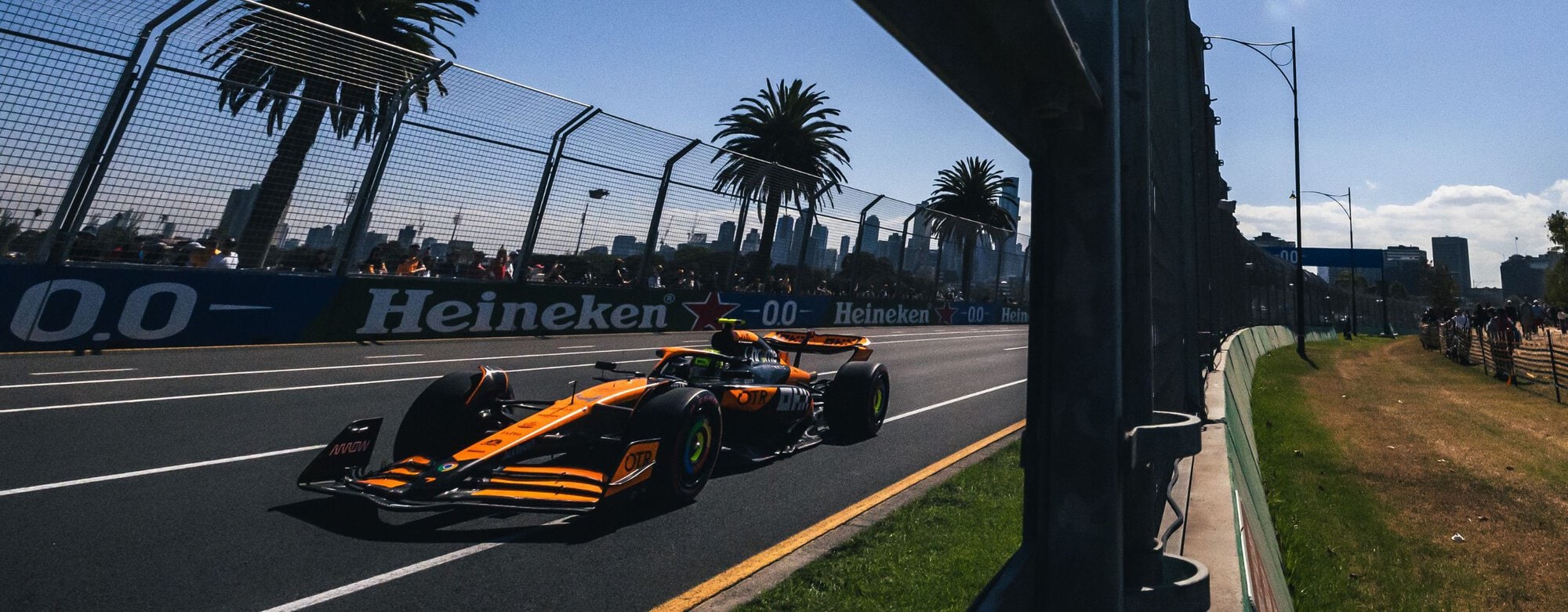
The circuit runs around Albert Park Lake, just a few minutes from the centre of Melbourne.
At first glance, it looks like a street circuit. In practice, it behaves differently. Some sections are permanent roads used all year. Others are only closed and prepared for racing during Grand Prix week.
The setting is part of the experience. The lake sits alongside the circuit. The city skyline rises on one side. The coast is not far in the other direction.
For visitors, this matters. Getting to the track is simple. You’re never far from hotels, restaurants, or transport. It feels connected to the city, not separate from it.

Traveling to Melbourne: What you need to know
Melbourne’s main international airport is Melbourne Airport, also known as Tullamarine.
Most long-haul routes involve one stop. Many travellers connect through the Middle East, with flights routing via Dubai, Abu Dhabi, or Doha. Others travel through Asia, most commonly via Singapore, Kuala Lumpur or Hong Kong. These routes are frequent and well established.
From London, total travel time to Melbourne is typically around 23 hours, depending on connection length.
Most international visitors need an Electronic Travel Authority (ETA) or an eVisitor visa, which can be applied for online before departure.
If you’re booking flights, the best value is often found between March and August. That timing works well for the Australian Grand Prix.
Arriving a day or two before the race weekend gives you time to recover from the journey, adjust to the time zone, and settle into the city before heading to the circuit.
How many days should you spend at the Australian Grand Prix?
It’s best to plan for four full days, from Thursday to Sunday. The Australian Grand Prix weekend starts earlier than many races, and Thursday is a full day on track.
Arriving for all four days means you’ll see every Formula 1 session and the complete support programme.
Alongside Formula 1, the weekend includes Formula 2, Formula 3, Porsche Carrera Cup, and Supercars. There is track action from morning to evening each day, so staying through Sunday gives you the full picture of how the event unfolds.
Australian Grand Prix weekend schedule at a glance
Here’s a simple breakdown of what happens each day at the Australian Grand Prix.
Thursday opens the weekend with practice and qualifying sessions for Porsche Carrera Cup and the Supercars Championship. The circuit is active throughout the day, and it’s a good opportunity to get familiar with the venue.
Friday includes the first Formula 1 running of the weekend, with two practice sessions. Formula 2 and Formula 3 begin with practice and qualifying, while Porsche Carrera Cup and Supercars continue on track.
Saturday starts with Supercars Championship qualifying. Formula 1 then runs its third practice session, followed by support races. Formula 1 Qualifying takes place later in the day and sets the grid for Sunday.
Sunday begins with support series races in the morning. The Formula 1 drivers’ parade follows, before the Australian Grand Prix takes place in the afternoon.

Best places to stay for the Australian Grand Prix
Most travelling fans stay in the centre of Melbourne. It’s the easiest place to base yourself if this is your first visit. You’ll find a wide range of hotels, plenty of places to eat, and simple public transport to the circuit. Staying in the city also gives you more flexibility if you book later, as hotels near the track tend to fill first.
City-centre hotels work well if you plan to use trams. Hotels such as QT Melbourne, Pan Pacific Melbourne, and Rydges Melbourne have direct and reliable tram connections to the circuit. Travel time is usually between 15 and 25 minutes.
If you prefer to stay near the circuit, there are a small number of hotels along St Kilda Road and around Albert Park itself. Pullman Melbourne Albert Park and Mercure Melbourne Albert Park sit directly next to the circuit. From here, you can walk to the gates and avoid transport altogether. Oaks Melbourne St Kilda Road is also nearby and well connected.
A short distance from the circuit, Royce Hotel and Coppersmith Hotel remain easy to reach from Albert Park.
For most first-time visitors, the city centre remains the simplest choice. You stay connected to Melbourne, and the circuit fits naturally into your day.
We’ve included links below if you’d like to search for hotels and compare rates. They help support our guides, at no extra cost to you.
ZenHotels is one of my go-to sites for hotel bookings. It pulls prices from loads of smaller sites you might not know about, so it’s great for finding deals. I also check Expedia and Booking.com when I want more options.
Race weekend travel at the Australian Grand Prix
If you are flying into Melbourne, you will arrive at Melbourne Airport. The SkyBus runs between the airport and the city centre, day and night. The journey usually takes around 30 minutes. Taxis are also available from the airport.
Once you are in the city, public transport is straightforward to use. Albert Park is close to Melbourne’s city centre, so staying next to the circuit is not necessary. Most fans travel in from the city by tram. Driving or parking near the circuit is usually avoided.
Melbourne’s tram network covers most central areas and connects well with the route to Albert Park. If you choose a hotel close to a tram stop, travel time from the city centre can be as little as 15 to 25 minutes.
Rideshare services operate across Melbourne and can be booked through mobile apps. Taxis are also easy to find at taxi ranks or along busy streets. Ride-share prices often increase during peak periods, especially after the Grand Prix. Waiting times can also be long. Public transport is often the more reliable option at those times.
Best Grandstands for key moments
Albert Park is a semi-street circuit. Parts of the track use public roads, while other sections are built specifically for racing. That mix gives the circuit its character. It’s fast in places, narrow in others, and there is little room for error.
Early in the weekend, grip can be limited and the surface is often bumpy. Drivers talk about the need to build confidence lap by lap. Once they do, the layout encourages commitment. That’s why key moments tend to happen under braking and through the faster sections of the lap.
Where you sit will shape how you experience those moments.

- Fangio Grandstand – Located on the start/finish straight, this grandstand has a front-row seat to the race start, pit stops, and podium celebrations.
- Moss & Jones Grandstands – Positioned at Turn 1, these stands give you a great view of the first lap action, late braking moves, and potential overtakes into the opening corners.
- Brabham Grandstand – Directly opposite Turn 1 and Turn 2, offering a fantastic vantage point to watch the cars jostle for position in the opening laps.

- Hill Grandstand – Located at Turn 3, a key overtaking zone where you can see drivers battle for position after the DRS zone.
- Ricciardo Grandstand – Facing Turn 4, this spot is perfect for seeing drivers fight back after being overtaken at Turn 3.
- Waite & Clark Grandstands – Both positioned along Sector 2, these offer views of one of the fastest parts of the circuit, where cars whip through high-speed chicanes.
- Prost, Senna & Schumacher Grandstands – These stands provide a final sector view, where strategy and last-lap battles can make all the difference before the cars head into the home straight.
Tickets at the Australian Grand Prix are split between grandstands and general admission. Grandstands give you a reserved seat and a fixed view. General admission allows you to move around the circuit and watch from grassed areas and standing zones. Both offer a good experience, but they suit different ways of watching the race.
Albert Park is an open venue, and weather conditions can vary. Some grandstands offer limited shade, while others are fully exposed. Hats, sunscreen, and light layers are common, especially across a full day at the circuit.
Tickets
Motorsport Tickets and Grand Prix Tickets are the two agencies I’ve trusted for years. They’ve always been reliable, easy to deal with, and quick to help if something comes up.
Where next after the Australian Grand Prix?
The Australian Grand Prix often sits within a longer trip. Melbourne works well both before and after race weekend. It’s an easy city to spend time in.
The most common trip outside the city is the Great Ocean Road. It’s a coastal drive that shows a very different side of the area. The route passes through towns such as Torquay and Lorne, then continues along the coast. The Twelve Apostles are the best-known stop, but the drive itself is the main reason people go.
If you prefer to stay closer to Melbourne, the Yarra Valley is an easy option. It’s quieter than the coast and works well if you want a slower day after the race.
For many visitors, adding one or two days after the Grand Prix is enough.